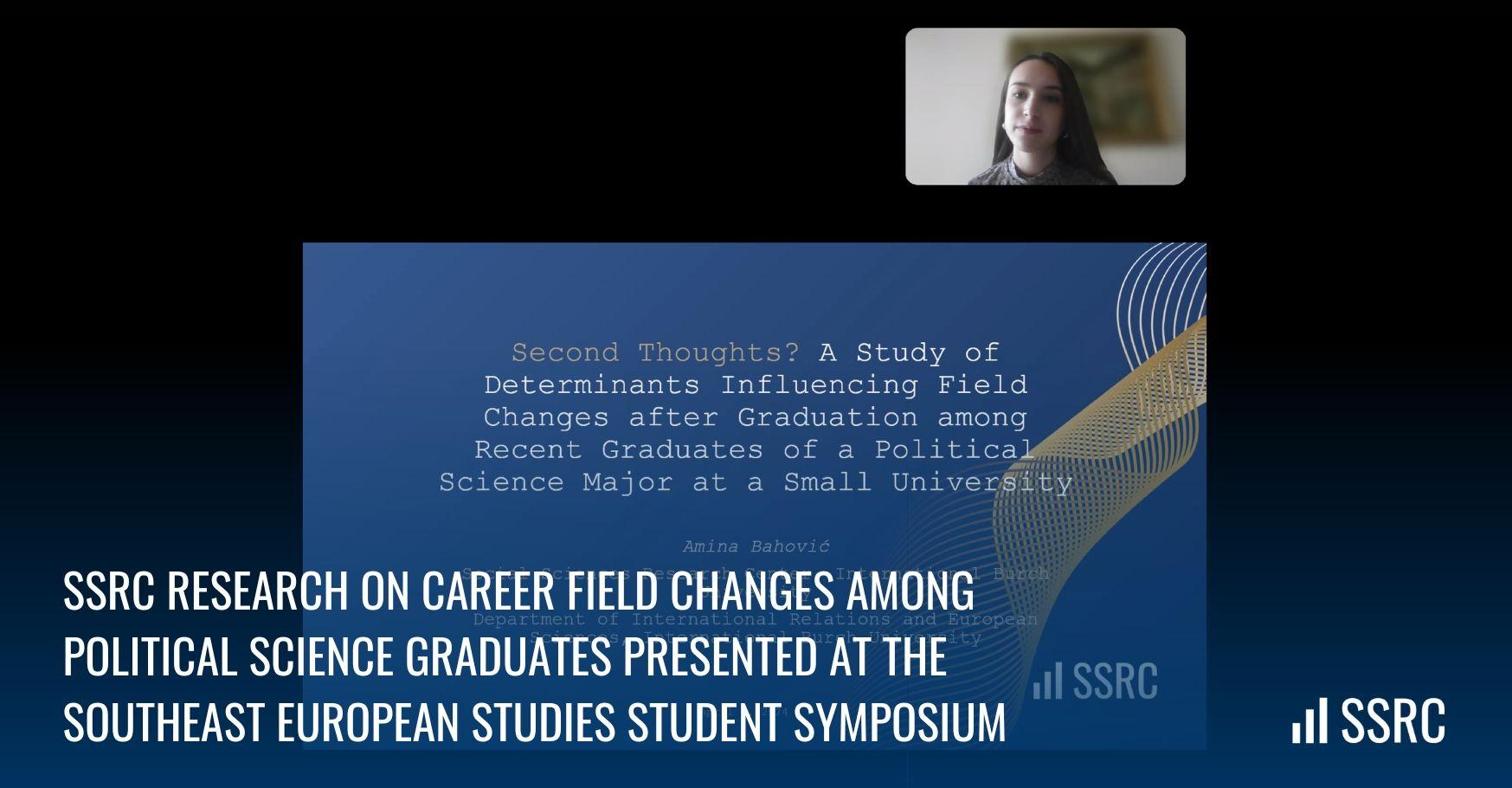
Amina Bahović, a junior researcher studying students’ post-graduation life trajectories at the Social Sciences Research Center at International Burch University, presented research entitled “Second Thoughts? A Study of Determinants Influencing Field Changes after Graduation among Recent Graduates of a Political Science Major at a Small University,” at the Southeast European Studies (SEES) Student Symposium.
The SEES Student Symposium constituted an opportunity for students interested in Southeast Europe to connect, serving as a platform for exchange and feedback on current research projects. More than 20 papers were presented by as many students from various universities across the region, including universities such as the University of Graz, the University of Regensburg, and the University of Jena.
Bahović studied the rising trend of individuals changing careers, which has become particularly salient among the Great Resignation following the covid-19 crisis and the industry-wide impacts of which are becoming increasingly visible.
The paper closely follows over 30 recent graduates from the Department of International Relations and European Studies, adopting a quasi-ethnographic approach and leveraging in-depth interviews to determine the influences in students’ pre-university, university, and post-university lives have in determining their career decisions.
The result juxtapose alumni choices on pursuing further studies in the field (of political science) or other fields with their choices of pursuing a professional career in the field or another, with preliminary results indicating participating in extracurricular activities during studies, participation in mobility program, and academic success are all salient factors that contribute to the identified shifts.
Of the 30 participants, over a quarter (8) both pursued further studies and a professional career in the field, while half that amount pursued further studies and a professional career in a different field. A further sixth pursued further studies in a related field but pursued a professional career in a different field.
Although ongoing, the research contributes to the development of determinants driving such changes at various inflection points. It is a part of wider research agenda at the Social Sciences Research Center that looks at youth policy at the local, regional, national, and supranational levels, which is currently at the stage of developing a wide initial evidence base.
The abstract, among others presented at the SEES Student Symposium, can be found here.